Imprisonment for debt
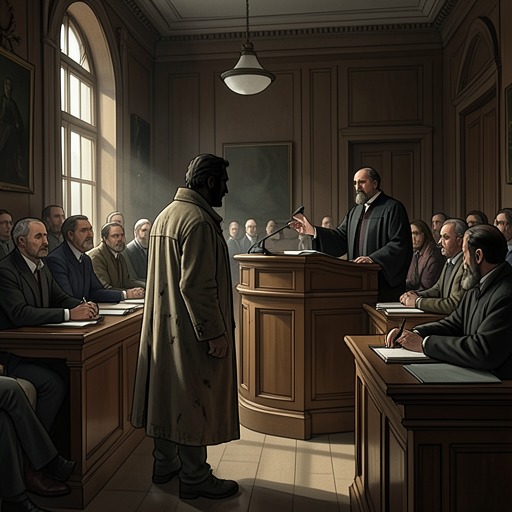
David CopperfieldImprisonment for debt in David Copperfield is a civil response to unpaid obligations, but its effects reach well beyond the person named in a claim. The threat of arrest shapes what a household can afford, who must help sustain it, and how family members remember a period of confinement. Through Mr. Micawber’s successive encounters with the law, the novel presents imprisonment not as a final settlement of debt but as one stage in an unstable cycle of creditor pressure, arrest, petition, release, and renewed danger.
Debt and Household Insecurity
Before Mr. Micawber is imprisoned, the prospect of creditors acting against him already governs domestic life. Mrs. Micawber expects that if creditors will not allow time, the matter will be forced to a conclusion, while insisting that nothing can presently be collected from her husband. Her account places the family’s difficulty in practical terms: payment is demanded, but the resources to meet it are absent. Creditors visit the household, and the family’s efforts to manage its immediate needs unfold under that pressure.
David Copperfield lives with the Micawbers while working at Murdstone and Grinby’s warehouse. His small weekly earnings must cover his own food, and he describes having no adult counsel or support through the working week. When Mrs. Micawber says that the household has almost nothing left to eat, David offers her the two or three shillings he has saved. She refuses to take the money as a loan, but accepts his help in raising funds by selling the family’s possessions. His childhood labor and the Micawbers’ financial distress thus meet in a domestic economy where even modest sums and belongings matter, and where debt affects people who are not themselves the targets of a creditor’s claim.
Arrest and Life in the King's Bench
When Mr. Micawber’s difficulties reach a crisis, he is arrested early in the morning and taken to the King's Bench Prison in the Borough. His announcement to David that his prospects have collapsed makes the arrest feel like a personal catastrophe; later that morning, however, he is reportedly seen playing skittles. The contrast does not cancel the seriousness of confinement. It shows the oscillation between despair and composure that marks his responses to financial reversals.
On the first Sunday after the arrest, David follows Mr. Micawber’s elaborate directions through streets, a yard, and a gate to reach him. They meet inside the prison and go to Mr. Micawber’s room, on an upper floor. The visit includes a shared meal with another debtor, whose family and cramped circumstances David also observes when he borrows a knife and fork. The episode makes confinement part of a wider social setting: the prison contains households and personal relationships, rather than isolating the consequences of debt to the person arrested.
Mr. Micawber gives David a lesson in living within one’s income: spending slightly less than one earns, he argues, permits happiness, while spending slightly more brings misery. Even in prison, the lesson is accompanied by a small transaction: he borrows a shilling for porter and gives David a written order to recover the amount from Mrs. Micawber. Advice, borrowing, and formal acknowledgment of an obligation sit side by side. The episode makes the prison an extension of the family’s financial dealings, not an escape from them.
Petition, Discharge, and Moral Obligation
Mr. Micawber’s confinement does not end with the arrest. His petition is eventually heard, and he is ordered discharged under the applicable Act. The creditors are not presented as uniformly vindictive: Mrs. Micawber reports that even a boot-maker who had pursued payment said he bore no personal malice, while maintaining that money owed should be paid. The exchange distinguishes a creditor’s claim from personal hatred, without suggesting that the resulting legal process is painless for the household.
Discharge also requires further steps. Mr. Micawber returns to the King's Bench while fees and formalities remain to be settled before he can leave. The prison community welcomes him, and an evening gathering marks his return, while Mrs. Micawber and David share a meal separately with the sleeping family. Release is therefore neither instantaneous nor simply a return to ordinary life: it has procedures, and its celebration occurs within the household’s continuing material strain.
The novel also connects debt to obligations among friends. Before leaving London, Mr. Micawber acknowledges that Thomas Traddles had twice put his name to bills to accommodate him. He calculates the combined amounts and gives Traddles an IOU, insisting on the importance of settling the obligation before departure. This gesture presents indebtedness not only as exposure to creditors and legal enforcement but as a moral responsibility within personal relationships. The written promise cannot erase the earlier difficulty, but it records Mr. Micawber’s attempt to recognize what he owes.
Recurrence and the Limits of Release
Years later, Mr. Micawber recalls the King's Bench as a place where he and his family had been familiar with every stone. He remembers his children tracing the patterns cast by the prison’s ironwork across the ground. The memory shifts attention from the debtor alone to the children who share the consequences of confinement, and it gives the prison a lasting place in the family’s history. Mr. Micawber also contrasts his former life there with his changed circumstances, describing the loss of the old relations he had had with other men. Release did not restore the life he once knew unchanged.
The danger returns when the Micawbers are preparing to emigrate with Betsey Trotwood’s proposed arrangements. After Mr. Micawber rushes out to buy stamps for his notes of hand, he returns in the custody of a sheriff’s officer, explaining that proceedings connected with Uriah Heep have intervened. A subsequent letter reports another writ in a case styled Heep against Micawber and warns of confinement in the city’s debtors’ prison. The renewed threat interrupts the family’s preparations and reveals that discharge from one crisis has not protected Mr. Micawber from another.
These later proceedings are bound up with Mr. Micawber’s accusations that Uriah Heep used his position to bring about Mr. Wickfield’s financial ruin. The narrative therefore distinguishes ordinary inability to pay from the alleged manipulation at the root of this later conflict. Imprisonment remains a real prospect for Mr. Micawber even as he seeks to expose the conduct he believes responsible for the losses. The recurring writs make the law’s power visible, while leaving open the difference between a debtor’s liability and the disputed origins of that liability.
Narrative Significance
Across these episodes, debt imprisonment is shown through its consequences for work, food, friendship, family life, and plans for the future. David’s youthful assistance to the Micawbers, Mr. Micawber’s brief imprisonment and eventual discharge, and his later return to danger form a connected account rather than a single episode of punishment. The law can order release, but release does not itself supply security, settle every personal obligation, or prevent fresh proceedings.
The prison’s remembered details and Mr. Micawber’s repeated encounters also prevent debt from remaining an abstract figure in an account book. It becomes a pressure that children witness, that friends try to mitigate through loans and written promises, and that can reappear just as a family hopes to leave its troubles behind. The novel’s treatment of imprisonment for debt thus joins legal procedure to domestic vulnerability, while keeping distinct the claim that money is owed and the question of how a person came to owe it.